Baccarat Mathematical Frameworks and Their Alignment With Digital Security Benchmarks
Written by Dana Patterson · Sep 23, 2026

Baccarat Mathematical Frameworks and Their Alignment With Digital Security Benchmarks
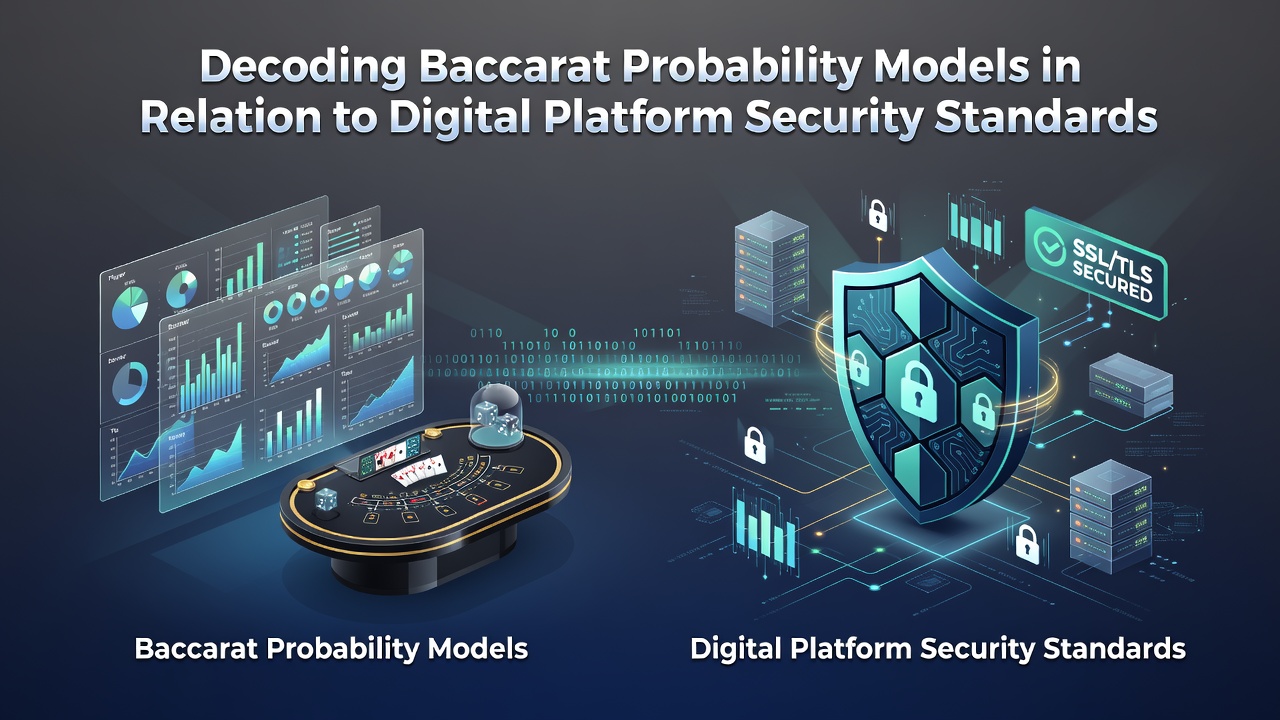
Probability calculations in baccarat rest on fixed mathematical distributions that digital platforms must preserve through certified random number generators and encryption protocols, and observers note these models remain consistent across millions of simulated hands when systems undergo regular audits by independent laboratories. The banker hand wins approximately 45.86 percent of the time while the player hand succeeds in about 44.62 percent of rounds with ties occurring near 9.52 percent according to historical outcome tallies compiled by gaming research groups. These ratios derive from the finite deck structure and drawing rules rather than variable factors yet platforms enforce them only when random generation meets standards set by bodies such as the Nevada Gaming Control Board.
Core Probability Structures in Baccarat
Each hand follows a strict sequence of draws where the third card rules depend on initial totals and analysts track these sequences to confirm that long-term frequencies match theoretical expectations, while deviations trigger investigations into generator integrity. Data from large-scale simulations reveal that house edges stay locked at roughly 1.06 percent for banker bets and 1.24 percent for player bets when no commission variations apply, and such figures hold steady only under audited conditions that prevent pattern manipulation. Researchers at institutions focused on gaming mathematics have documented these outcomes across thousands of trials yet security layers determine whether the models translate accurately into live sessions.
Integration With Platform Security Protocols
Digital environments apply cryptographic hashing and seed management to random number generators so that probability distributions cannot be predicted or altered by external actors, and certification processes verify that output sequences produce banker and player results within expected margins. Standards from organizations like the Malta Gaming Authority require continuous monitoring of variance metrics which ensures that actual results do not stray beyond statistical tolerance bands, whereas weaker implementations risk clustering that undermines player trust. Platforms often incorporate multi-layer encryption for data transmission between client devices and servers because compromised channels could expose seed values and thereby allow forecasting of future hands.
One study conducted by a Canadian research consortium examined generator performance across multiple jurisdictions and found that certified systems maintained banker win rates within 0.2 percentage points of theoretical values over extended periods. External audits conducted quarterly or more frequently detect anomalies that might indicate hardware faults or software tampering, and operators must then isolate affected modules until re-certification occurs. Those who manage large-scale deployments emphasize that probability fidelity and security measures operate as interdependent components rather than separate functions.
Regulatory Developments Expected by September 2026
Updated technical requirements scheduled for September 2026 will introduce enhanced entropy testing for generators used in baccarat environments according to preliminary guidance from the Australian Communications and Media Authority alongside input from European technical working groups. These revisions aim to address emerging quantum computing threats that could theoretically compromise older pseudo-random algorithms, and operators are already testing post-quantum resistant methods to maintain outcome unpredictability. Compliance timelines require full migration by the end of that year so that probability models continue to reflect true randomness under strengthened verification regimes.
Industry reports from the International Association of Gaming Regulators highlight how cross-border platforms must align with multiple overlapping standards simultaneously, and this creates layered audit trails that document every generator reseed event along with corresponding hand outcome logs. Data compiled through such processes allow regulators to compare real-world frequencies against baseline models on a per-jurisdiction basis.
Verification Methods and Ongoing Monitoring
Independent testing laboratories apply chi-square and runs tests to generator output streams to confirm uniform distribution across possible card sequences, while platforms retain raw logs for regulatory review periods that often span several years. When anomalies surface, investigators reconstruct the exact sequence of draws to determine whether the deviation stems from hardware issues or attempted interference. Academic papers published in journals focused on applied probability have explored similar monitoring frameworks and concluded that continuous statistical oversight provides the most reliable safeguard for maintaining expected baccarat frequencies.
Operators integrate real-time dashboards that flag when cumulative results approach tolerance limits, allowing immediate pauses for further diagnostics, and such systems reduce the window during which flawed data might influence player decisions. Evidence gathered from multiple regions shows that jurisdictions enforcing these practices experience fewer disputes related to perceived unfair outcomes.
Conclusion
Baccarat probability models function as fixed benchmarks that digital security architectures must protect through certified generation, encryption, and periodic validation, and frameworks established by diverse regulatory entities ensure these benchmarks remain intact across evolving technological landscapes. Continued alignment between mathematical expectations and platform safeguards supports consistent operation regardless of scale or jurisdiction, while scheduled enhancements through 2026 will further reinforce this relationship.